
Biedrība “Dr.Klauns” Reģ.nr. 40008199816
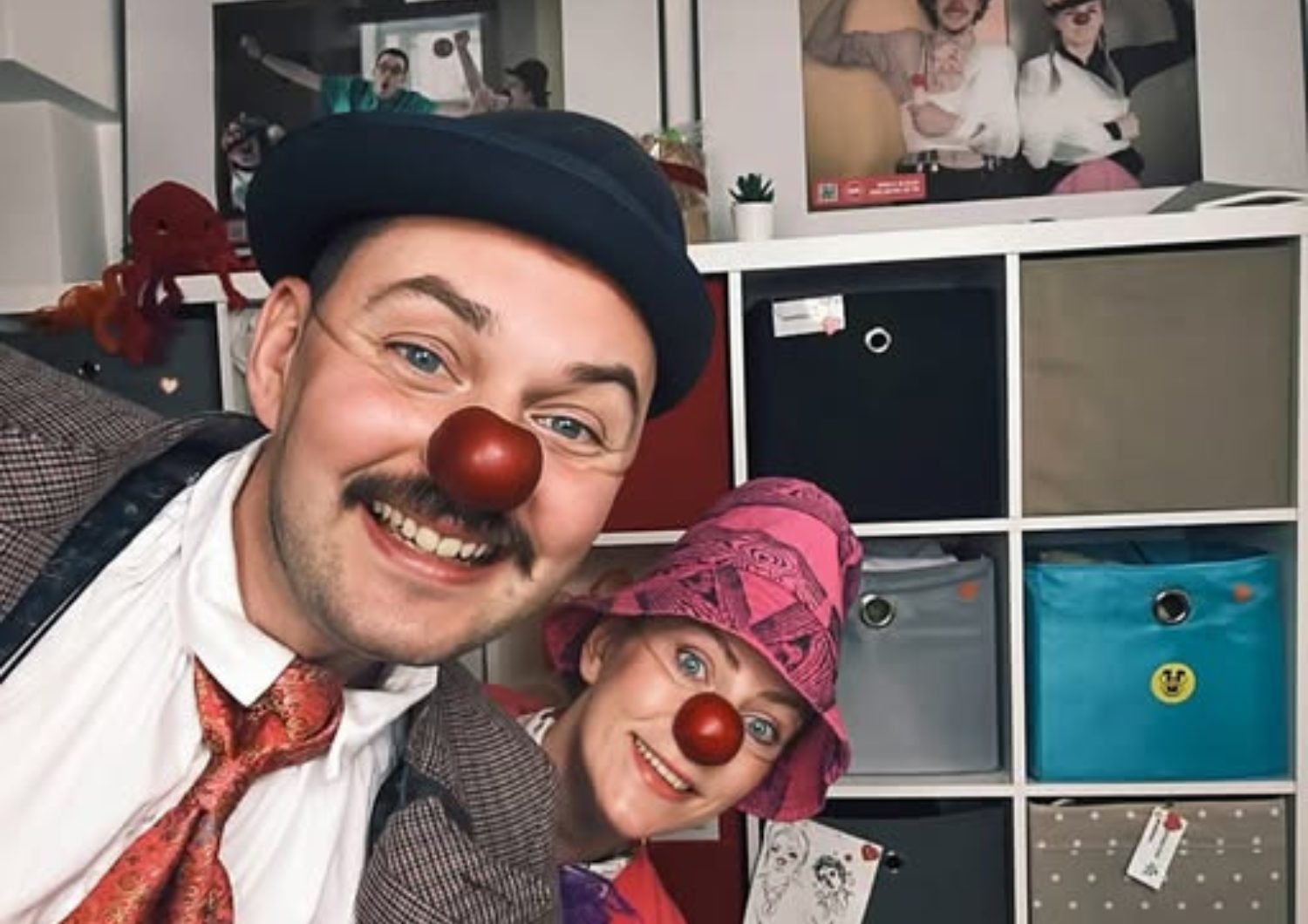
“Being a medical clown means being ready to react in a hundredth of a second. In the everyday life of a hospital, situations change rapidly – from quiet calm to sudden excitement.” says Dr. Vilnis Zeķītis, or Jānis Taukulis, the medical clown.
This is a story from the Emergency Medical Centre (EMC), where my colleague Yvette Brouwer, aka Dr. Bruvi, and I see how a little game helps to overcome a big fear.
Our shift starts as usual – first we talk to the medical staff to find out where we are most welcome today. Then we go our clown way.
As we walk past a ward, our eyes stop on a little boy (about two years old). He is upset and crying, and the nurse is getting ready for work. We understand that this is our moment.
At first, the boy won’t let us near him, so we have to look for a “key”. I have a very simple piece of plastic bag in my pocket. I launch it into the air and it goes slowly, but then I blow it up and – the film starts swirling in the air. That’s the first “click” – the crying stops. Little eyes start to follow the movement.
Bruvy and I start humming and making funny noises, gradually coming more and more inside the ward, but still keeping our distance. Then I use the squeaky one in my pocket. Bruvy and I are trying hard to find where this sound is coming from. The boy starts laughing sweetly. When the beep starts to sound non-stop, “toe-feet” come out of my pocket and start tickling the boy. The game has completely connected us!
But then comes the climax – the boy has to go to the treatment room to have his bandaged head stitched up. The medical staff invites us along. As we walk down the corridor, we continue the game, and he forgets even about his pain. But when you enter the procedure room, the fear returns with renewed force – tears and hysteria.
In these moments, the clown has to act as a skilful director – constantly changing the “script” to keep the child’s attention. First, I put the squeaker in his hands and let him squeeze it himself. When the boy’s attention wanes, I use the bag again – its calm fluttering helps to calm him down for a moment.
When this becomes habitual, we start making strange, unexpected sounds, and then I’ll make a loud – bleep! – my feet hit the ground.
Finally, Bruvy and I start to sing – quietly and peacefully: a round apple bakes slippers for a pear… The boy listens, smiles, and – at that moment – the procedure is over! The seam is sewn, and the great fear is healed.
This case illustrates one of the main techniques of medical clowning – distraction. In a child’s world, fear tends to fill the whole room, and during a painful procedure, his or her attention is completely fixed on what is scary.
The clown’s job is to fill that fear-filled space with something else. This time we worked in cycles: from a louder beep to a calm song, changing the stimuli all the time so that the child’s mind didn’t revert to fear. We can’t promise a child it won’t hurt, but we can create a safe bubble where song and laughter are more important than what’s going on around them. This way, the child does not get traumatised by the experience, and the medics can do their job in peace.
Help Doctor Clown be where he is expected – with children in hospitals. Your regular donation helps to bring smiles, lightness and joy to the places that need them most. Sign up for regular payments on our website: https://www.drklauns.lv/donate/ and help the joy to be there at the right time.